
Exporting Cosmetics to Indonesia: SKI, LS and Tariffs Explained
Published 2026-11-28 17:44:47 · Tiensi
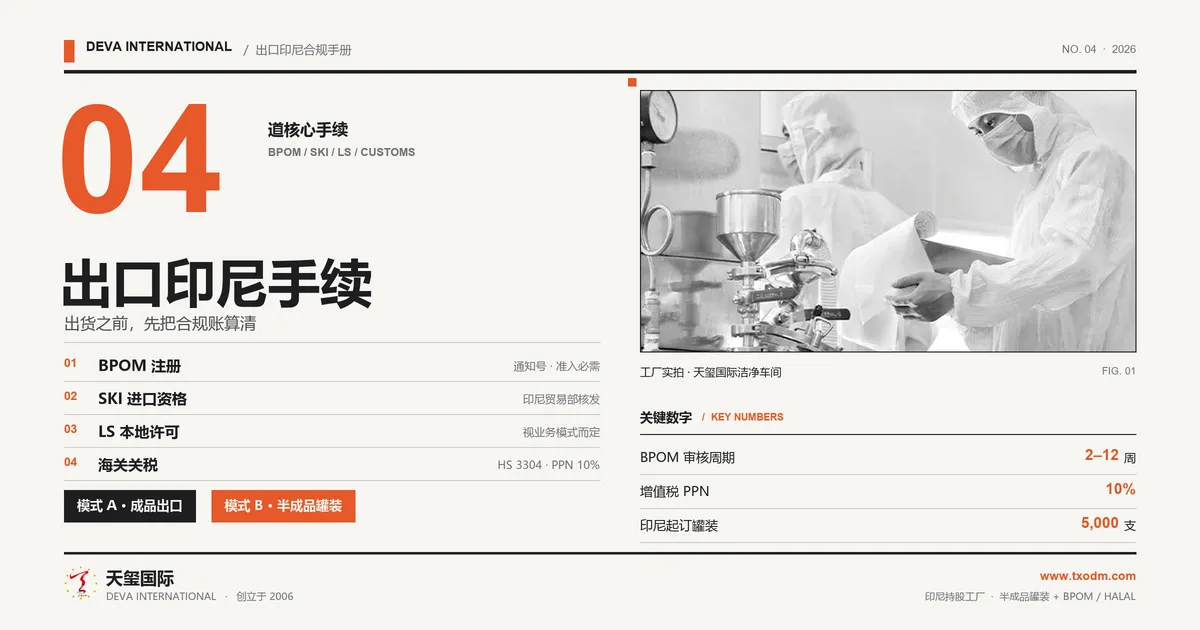
Q1: Must BPOM registration be handled by an Indonesian company? Yes. The applicant must be a local Indonesian entity, and overseas brands usually appoint an importer or a local plant to handle it.
Q2: Which comes first, SKI or BPOM? Run them in parallel. SKI applies to importer status and BPOM to the product itself; neither replaces the other. Q3: Can exporting semi-finished product save duty? Semi-finished products are classified differently from finished goods and the duty logic differs. It depends on the HS classification and the agreement tariff rate, so it is best to estimate the duty cost first. Q4: Is halal certification mandatory? Indonesia has a high Muslim share of the market and mainstream channels mostly require HALAL, making it an effective entry barrier.
I. Market Access in Indonesia: BPOM Registration Is the First Gate
In Indonesia, every cosmetic sold must be registered or filed with BPOM (Badan POM, the Food and Drug Supervisory Authority) and obtain a notification number (Nomor Notifikasi) before it can circulate locally. This step is comparable to a domestic filing or registration, only the authority changes. Without a notification number, goods cannot be cleared or listed even if they have already reached the port.
Materials required include the product formula, a safety assessment report for the ingredients, a Certificate of Free Sale issued by the competent authority of the exporting country, label artwork (which must be in Indonesian), and the manufacturer's GMP or ISO system certificates. BPOM review typically takes anywhere from several weeks to two or three months, and special-use cosmetics such as brightening and sunscreen products require more complete efficacy and safety documentation.
II. The SKI Import Identification Document: The Importer's Passport
SKI stands for Surat Keterangan Impor, usually translated as an import identification document or import approval letter. It is issued by Indonesia's Ministry of Trade to importers who meet the required qualifications, confirming they are eligible to import specific product categories. For cosmetics, an importer must hold an SKI before it can declare goods to customs under the cosmetics tariff code.
An SKI is not obtained once per shipment — it recognises the importer entity itself, and its validity is tied to the importer's licence. In practice, if a brand exports finished goods directly to an Indonesian customer, the SKI is normally provided by the buyer's importer; if the brand sets up its own Indonesian entity or uses a nominee importer, it must apply itself or entrust a local agent.
III. The LS Approval and Local Production Licence: Two Different Models
In practice, the "approval letter" referred to as LS usually points to a locally relevant permit or number, whose exact form depends on the business model rather than a single fixed-format document:
- Direct import of finished goods: this mainly follows the BPOM notification number plus SKI route, so the need for an LS-type local permit is relatively weak;
- Setting up a plant in Indonesia or entrusting a local factory to produce: this involves local production permits and factory credentials, and here the LS-type number functions more like a "local production identity".
Put simply, LS is not a single document but a "model-dependent" set of local compliance pieces. To judge whether you need LS, first answer one question: are you selling imported goods, or making them in Indonesia? The answer also determines who files the subsequent BPOM registration.
IV. Customs Declaration, Duties and VAT
Once goods arrive, Indonesian customs classify them for duty purposes under the HS code. Cosmetics commonly fall under heading 3304 (beauty, make-up and skin care products). Basic import duty rates vary by subheading, generally modest but subject to the tariff schedule in force that year; on top of that, 10% VAT (PPN) applies, along with import-stage charges that may arise.
Several variables affect the tax bill: whether the declared value is accurate (under-declaring carries a high risk of being examined), whether HS classification is correct, and whether preferential rates under ASEAN free trade agreements apply (Indonesia has trade agreements with several countries, and a certificate of origin can reduce duty). Before shipping, it is worth having the customs broker produce a tax estimate so the cost does not exceed budget after arrival.
V. Finished Goods vs Semi-Finished Goods: How the Paperwork Differs
Model A: Exporting Finished Goods Directly
The brand completes all production and filling in China and exports the full batch of finished goods to Indonesia. The paperwork centres on BPOM registration (formulation data for the finished product) plus SKI (importer) plus duty. The advantage is that production is handled end to end at home; the disadvantages are large sea-freight volumes for finished goods, duty calculated on finished-goods value, and a separate BPOM notification number for every finished product.
Model B: Exporting Semi-Finished Goods for Filling in Indonesia
The brand exports the semi-finished product or bulk formula to Indonesia, where the local factory handles filling, labelling and local compliance. Semi-finished goods are usually classified as raw materials or intermediates, so clearance and tax logic differ; the BPOM notification number for the finished product is obtained by the Indonesian factory as the local entity, so the brand does not directly face the requirement that the registration entity must be in Indonesia. This model shifts the qualification burden onto a factory with local credentials, and the brand's paperwork becomes markedly simpler.
VI. The DEVA Model: Semi-Finished Export plus Filling in Indonesia
DEVA INTERNATIONAL holds a stake in a local manufacturer in Indonesia, and the model is that DEVA supplies the technical formula and semi-finished goods and exports them to Indonesia for filling, while the Indonesian factory handles BPOM registration and HALAL certification. For brands, this means: no need to establish an importing entity in Indonesia, HALAL certification (mandatory in Indonesia, where the halal market is the majority) handled by the local factory, and the BPOM notification number filed by a party holding local credentials. For more detail on overseas expansion manufacturing, see our cosmetics ODM and brightening and spot-fading special registration certificate service pages.
Filling labour is priced in tiers by specification and volume. For example, for >30ml/g: about IDR 3,310 per unit at 5,000 units, IDR 2,647 at 10,000, IDR 2,206 at 50,000 and IDR 1,766 at 100,000 units and above. The larger the batch, the lower the unit cost, which makes local filling accessible to small and mid-sized brands.
VII. Compliance Essentials and Common Pitfalls
- Labels must be in Indonesian, with ingredients, warnings, volume and production date localised;
- Arrange the Certificate of Free Sale and GMP certificates early rather than once shipping begins;
- Sunscreen and brightening products are special-use items with higher documentation requirements, so allow more time;
- Confirm the importer's credentials (the SKI holder) are valid, and do not declare customs against a licence about to expire;
- Plan halal certification early to avoid missing the sales window around Ramadan.
FAQ
Q1: Must BPOM registration be handled by an Indonesian company? Yes, the applicant must be a local Indonesian entity, so overseas brands usually entrust an importer or a local factory to handle it.
Q2: Which comes first, SKI or BPOM? Run them in parallel. SKI concerns importer credentials, BPOM concerns the product, and neither replaces the other.
Q3: Does exporting semi-finished goods save duty? Semi-finished goods are classified differently from finished goods, so the tax logic differs. The specifics depend on HS classification and agreement rates, so an estimate is recommended first.
Q4: Is halal certification mandatory? Indonesia has a high Muslim share of the population and mainstream channels largely require HALAL, making it a de facto condition of entry.
About DEVA INTERNATIONAL
Guangzhou DEVA Biotechnology Co., Ltd. (DEVA INTERNATIONAL) was founded in 2006 and has spent nearly 20 years focused on R&D and manufacturing of "fresh, active efficacy cosmetics". It is a high-tech enterprise across the full ODM/OEM value chain, guided by "Create Freshness · Real Efficacy", serving more than 300 leading and emerging beauty brands each year. The company is certified to ISO 22716 and GMPC and holds special cosmetics registration for sunscreen and brightening and spot-fading products, and can take on special registration certificate manufacturing and overseas compliance.
In Indonesia the company holds a stake in a local manufacturer, with DEVA supplying the technical formula and semi-finished goods and exporting them to Indonesia for filling, while the Indonesian factory handles BPOM registration and HALAL certification, helping brands expand into Southeast Asia and the wider ASEAN market. Visit www.txodm.com to explore the Product Centre and OEM/ODM services, or go to the contact page to discuss overseas expansion plans.
About DEVA INTERNATIONAL
Guangzhou DEVA Biotechnology Co., Ltd. (DEVA INTERNATIONAL), founded in 2006, has spent nearly 20 years on the R&D and manufacturing of "fresh-efficacy cosmetics", is a high-tech enterprise covering the full ODM/OEM chain for beauty and skincare, built on the philosophy "Fresh Creation, Real Efficacy", serving more than 300 leading and emerging beauty brands every year. The company is certified to ISO 22716, GMPC and other standards, holds special cosmetics registration certificates for sun protection and brightening and spot reduction, and can handle special-certificate manufacturing and overseas compliance. The company holds a stake in a local manufacturer in Indonesia. The model is for DEVA to supply the formula and semi-finished product, which are shipped to Indonesia for filling, while the Indonesian plant handles BPOM registration and HALAL certification, helping brands enter Southeast Asia (ASEAN). Visit www.txodm.com for the product centre and OEM/ODM services, or contact us via contact.html to discuss Southeast Asia plans.