HALAL Certification for Cosmetics: What It Is and How to Get It
Published 2026-11-27 17:54:52 · Tiensi
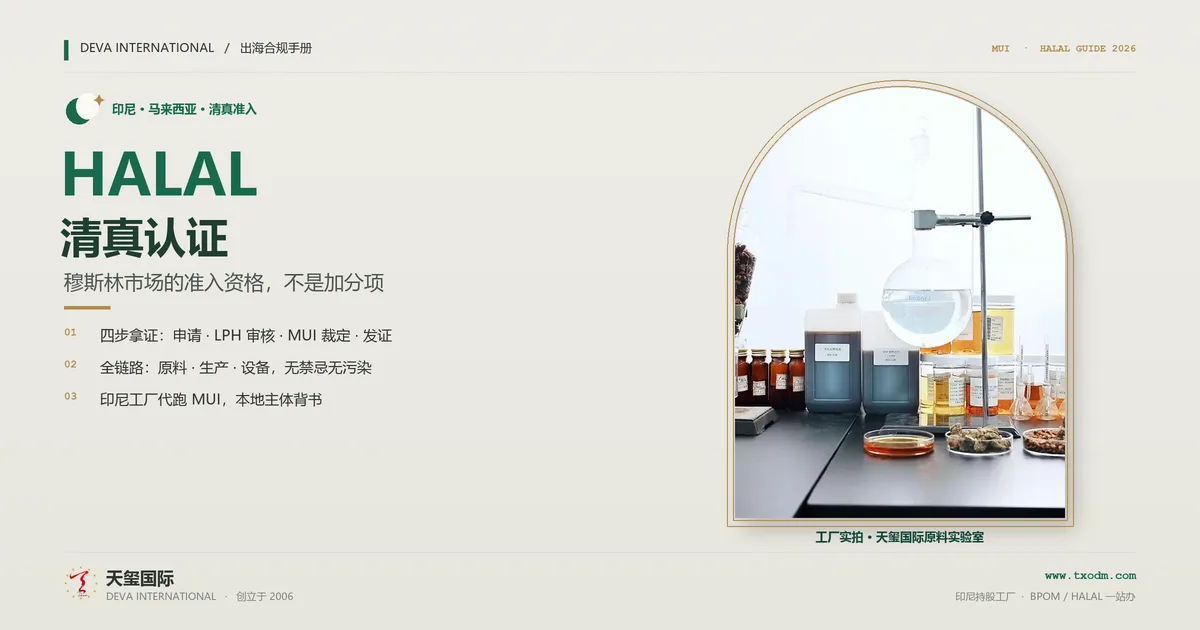
1. Application (document submission): compile the formula table, raw material halal declarations, process flow diagrams and label and packaging artwork, submitted to the LPH by the Indonesian entity.
2. LPH review (on-site and document review): the LPH (Lembaga Pemeriksa Halal, the halal inspection body) assigns inspectors to verify raw material compliance, the production site, and equipment cleaning and segregation. 3. MUI determination: The halal committee under MUI makes the final determination based on the LPH report and decides whether halal status is granted. 4. Certification: once the determination is passed, MUI formally issues the HALAL CERTIFICATE and assigns a certificate number, after which the product may be labelled and sold in compliance.
Want to sell into Indonesia or Malaysia but a "halal certificate" has shut you out of the market? For Muslim markets, cosmetics HALAL certification is not a nice-to-have — it is a condition of entry. Drawing on hands-on ODM experience, this article explains what HALAL means, who issues the certificates, how the application process runs and what it demands of your raw materials, then shows how brands can use DEVA's Indonesian factory to avoid wasted effort.
Before discussing how to get the certificate, it is worth understanding what HALAL actually is. Many brands meet the concept for the first time and read it as simply "a food hygiene standard for Islam", but for cosmetics its scope is far wider. Let's start with the meaning, then work through the certifying bodies and the practical process.
I. What HALAL Actually Refers To
HALAL means "lawful, permitted" in Arabic, and its opposite is HARAM (forbidden). Applied to cosmetics, it means that across the entire process — raw materials, excipients, production equipment, storage and transport — the product contains nothing Islam forbids, and has not been cross-contaminated with prohibited substances.
To put it on a concrete list, the following categories are effectively red lines in halal cosmetics: porcine-derived gelatin, collagen and glycerin; alcohol (ethanol) used as a solvent or penetration enhancer; certain animal fats (from animals not slaughtered according to halal requirements); and fragrance excipients containing animal-derived inputs. In other words, an ordinary "alcohol-containing toner" or a serum encapsulated in porcine gelatin caps is ruled out immediately under halal standards.
II. Why It Is a Hard Gateway in Indonesia and Malaysia
The global Muslim population has passed 2 billion, and Indonesia is the world's largest Muslim-majority country with a population of over 270 million; Malaysia and Brunei are also Muslim-majority. In these markets, the insistence on "halal" is not merely religious custom — it is law.
Take Indonesia as an example. Since the Halal Product Law began phasing in from 2019, cosmetics have been brought into the scope of mandatory halal certification, and products without a certificate cannot be lawfully marketed. In Malaysia, JAKIM is the authority, and the halal logo is likewise treated as a precondition for listing. For brands pursuing cosmetics ODM and overseas expansion, HALAL is not a question of whether to do it, but of how to do it faster.
III. The Certifying Body: Indonesia's MUI and the HALAL Certificate
In Indonesia, the body with genuine authority to rule is MUI (Majelis Ulama Indonesia, the Indonesian Council of Islamic Scholars). It is effectively the highest council of Islamic scholars in the country, and the HALAL CERTIFICATE it issues is the pass recognised by both the market and customs.
A compliant halal certificate states the certificate number, the holder (usually an Indonesian entity or importer), the product name, the manufacturing plant and the validity period. A number in the form ID00410012299021023 is the field most often requested during customs clearance, platform onboarding and channel verification. It is worth noting that MUI only deals with LPHs and local applicants inside Indonesia, so overseas brands generally need to apply through an Indonesian partner or local factory.
IV. The Complete Cosmetics Halal Certification Process
Under Indonesia's current mechanism, the chain breaks down into four steps. Knowing them in advance is what keeps a brand from slipping up at the handover points:
1. Application (document submission): prepare the formula table, raw material halal declarations, process flow charts, and label and packaging proofs, submitted by an Indonesian entity to the LPH.
2. LPH review (on-site and document inspection): the LPH (Lembaga Pemeriksa Halal, the halal inspection body) assigns auditors to verify raw material compliance, the production site and the segregation and cleaning of equipment.
3. MUI determination: the halal committee under MUI makes the final determination based on the LPH report and decides whether halal status is granted.
4. Certification: once approved, MUI formally issues the HALAL CERTIFICATE and assigns a certificate number, and the product may be labelled and sold compliantly.
Actual timelines vary from weeks to months depending on product complexity and how complete the documentation is. If the formula contains animal-derived or alcohol-based ingredients, the review stage often requires repeated evidence, which is why formulating for halal compliance at source compresses the certification timeline considerably.
V. Hard Requirements for Raw Materials, Production and Equipment
HALAL review watches most closely for a chain with no prohibited substances and no contamination. This lands on three levels:
Raw Materials
Every ingredient needs a traceable origin, with porcine-derived, non-halal-slaughtered animal and alcohol solvents excluded. Even trace excipients — fragrance carriers, capsule shells — must be halal compliant. It is best to prioritise suppliers who already hold halal declarations, which reduces the cost of substantiating claims later.
Production
If a single workshop also runs alcohol-containing or non-halal product lines, it must maintain clear batch segregation, dedicated production windows and cleaning validation records proving that cross-contamination does not occur. This is why more brands lean towards a dedicated halal production line.
Equipment
Reactors, pipes and filling heads that contact the product must be dedicated or cleaned to standard (CIP) with records retained; storage and transport likewise need to avoid co-location with non-halal materials. When auditors arrive, these records are the evidence that closes the assessment.
VI. How Brands Get HALAL Through an ODM Partner
For domestic brands, the least effortful route is to work with an ODM partner that has a local presence in Indonesia. DEVA INTERNATIONAL holds a stake in a local Indonesian manufacturer, and the model is: DEVA supplies the technical formula and semi-finished goods and exports them to Indonesia for filling, while the Indonesian factory handles Indonesia BPOM registration and HALAL certification. Brands do not need to build their own production line in Indonesia, yet still obtain a halal certificate backed by a local entity.
The core advantages of using an ODM partner to obtain the certificate are three: first, formula compliance is addressed upfront, with materials chosen to halal standards during R&D, avoiding rework after launch; second, communication with the local entity, LPH and MUI is handled by the factory, removing cross-border coordination costs; third, filling and certification are completed together, making clearance and listing timelines easier to control. DEVA's Guangzhou headquarters holds ISO 22716 and GMPC systems, which combined with its local Indonesian capability can take on the full chain from formula to HALAL overseas compliance in one stop.
If you are assessing halal cosmetics ODM options, confirm three things first: whether the factory has a legal entity in Indonesia, whether it can issue a halal certificate recognised by MUI, and how long certification has historically taken. These three points directly determine your overseas expansion timeline.
VII. FAQ
Q1: Are halal certification and the halal logo the same thing? No. The halal certificate (HALAL CERTIFICATE) is issued by MUI and similar bodies and is a credential document; the halal logo is a mark authorised under that certificate and printed on packaging. The two are bound together but cannot be used interchangeably.
Q2: If production is in China and the product is exported to Indonesia, which country's certification is needed? It depends on the target market. Selling into Indonesia requires an Indonesian MUI halal certificate; if you are also entering Malaysia, the JAKIM system applies as well. The two do not recognise each other and must be applied for separately.
Q3: Can an alcohol-containing toner still be made halal? Conventional ethanol solvents fall under the prohibited category in halal terms and generally cannot obtain certification directly. Compliant penetration alternatives or a solvent-free dosage form can be used instead, subject to the formula review outcome.
Q4: How long is the certificate valid, and what happens at expiry? Indonesian halal certificates have a validity period and require re-review and renewal before expiry. If the formula, production line or factory changes during that period, the change should be declared promptly so the certificate does not lapse and disrupt sales.
About DEVA INTERNATIONAL
Guangzhou DEVA Biotechnology Co., Ltd. (DEVA INTERNATIONAL) was founded in 2006 and is a high-tech enterprise across the full ODM/OEM value chain, focused on R&D and manufacturing of "baby-and-child-grade skincare" and "fresh, active efficacy cosmetics". Its guiding principle is "Create Freshness · Real Efficacy", and it serves more than 300 leading and emerging beauty brands each year. In Indonesia it holds a stake in a local manufacturer: DEVA supplies the formula and semi-finished goods and exports them to Indonesia for filling, while the Indonesian factory handles BPOM registration and HALAL certification, helping brands enter Southeast Asia at a lower barrier. DEVA is certified to ISO 22716 and GMPC, and can take on special registration certificate manufacturing and overseas compliance. Learn more at www.txodm.com.