
Indonesia BPOM Registration: The Complete Process Explained
Published 2026-11-26 17:20:50 · Tiensi
Before we begin
Treat "BPOM registration for cosmetics in Indonesia" as the first gate for exporting there. Many new brands only discover after the container has arrived that without a registration number it cannot even clear customs. Indonesia's BPOM (Badan Pengawas Obat dan Makanan, the food and drug authority) operates a mandatory notification and registration system for cosmetics. Products without approval may not be sold in the Indonesian market. The complete path from document preparation to receiving the approval notification number is broken down below, along with how brands should choose a manufacturer with genuine local execution capability.
Before We Begin
Treat "Indonesia cosmetics BPOM registration" as the first gateway into the Indonesian market. Plenty of new brands only discover after their container has landed that without a registration number the goods simply cannot be cleared. Indonesia's BPOM (Badan Pengawas Obat dan Makanan, the Food and Drug Supervisory Authority) runs a mandatory notification and registration system for cosmetics, and no product may be sold in the Indonesian market without approval. Below we break down the full path from document preparation to receiving the notification number, and look at how a brand should choose an ODM partner with genuine local capability.
I. First, What Indonesia BPOM Registration Actually Covers
BPOM is the Indonesian government body responsible for supervising food, medicines and cosmetics, and it reviews the pre-market notification (Notifikasi) for every cosmetic. Since 2015, all imported and domestic cosmetics must pass BPOM notification and obtain a notification number (Nomor Notifikasi) before they can be cleared, listed and advertised. Without that number, e-commerce platforms delist the product and offline channels will not take the goods.
One point worth noting: cosmetics in Indonesia operate under a notification system rather than an approval system. Review focuses on the completeness of documentation and formula safety, and does not test efficacy. That said, products such as sunscreen and brightening and spot-fading treatments are classified in Indonesia as special-use categories, where control is stricter and the documentation heavier. If a brand is also targeting Muslim consumers, HALAL certification is typically layered on top, and the two run on separate systems, so it is best to schedule both early.
II. The Complete Indonesia BPOM Registration Process (Timeline)
Q1: Are BPOM registration and HALAL certification the same thing?
No. BPOM governs safety and compliance for market entry, while HALAL governs halal compliance. The two systems are separate, so running them in parallel avoids lengthening the time to market.
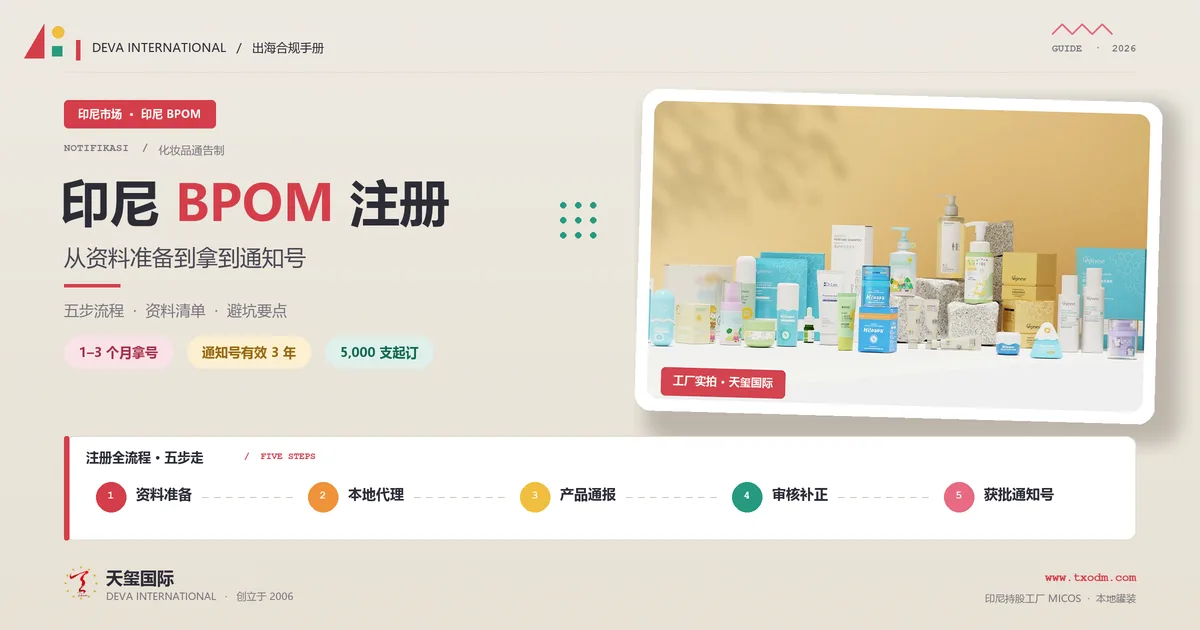
In practice the process runs in roughly five steps, and brands should keep a close eye on steps 1 and 2, because they take the longest and are the most likely to stall.
III. What Documentation Registration Requires
Whether the documentation is complete directly determines how smoothly the review goes. The categories below are the most frequently requested and the easiest to miss.
1. Formula and Full Ingredient List
All ingredients and their percentages must be listed under INCI names, with colourant index numbers (CI Number) noted. Indonesia applies the ASEAN Cosmetic Directive to certain prohibited and restricted substances — hydroquinone and some UV filters, for example, carry clear upper limits — so the formula should be checked against these from the outset.
2. Labelling and Packaging Copy
Labels must be in Indonesian and include the product name, use, full ingredient list, net content, production batch number, shelf life, country of origin, and importer or local responsible party details. Claims must not include out-of-bounds wording such as "treatment" or "medicinal", otherwise the product will be judged non-compliant.
3. GMP and Production Credentials
The factory's GMP certificates (such as ISO 22716 and GMPC) are mandatory. This is exactly where an ODM partner's credentials earn their value — a manufacturer such as DEVA INTERNATIONAL, already certified to ISO 22716 and GMPC and holding special registration certificates for sunscreen and brightening and spot-fading products, presents documentation reviewers trust, so fewer rounds are lost.
Q2: How long is a notification number valid?
It is usually valid for three years and must be renewed before expiry. A major change to the formula or label may require notification again.
4. Test Reports and Certificate of Free Sale
Microbiological, heavy metal and stability test reports, plus a Certificate of Free Sale issued by the country where the factory is located, usually with embassy legalisation or the Hague Apostille. Timelines here are flexible, so start them alongside production scheduling.
Tip: have the documentation pre-reviewed by a team that knows Indonesian regulations. We have seen a restricted ingredient exceed its limit by 0.1% and the entire batch sent back for rework, wasting two whole months.
IV. Timeline, Costs and the Usual Pitfalls
If things go smoothly, a single product takes roughly 1–3 months from complete documentation to notification number; special-use products, or those needing many corrections, can stretch to six months. On cost, government fees are modest — the larger items are local agent service fees, document translation and notarisation, testing and certification. What brands should really calculate is the cost of time: missing the retail peak around Ramadan costs far more than the official fees.
- Pitfall one: no access to a local submission account. Overseas companies cannot file on their own and must work through the CIPR account of an Indonesian importer or factory; pick the wrong partner and the submission will not even enter the system.
- Pitfall two: label translation errors. Non-compliant ingredient names or claim wording lead to immediate rejection, doubling the timeline.
- Pitfall three: ignoring HALAL. With a large Muslim consumer base, going without HALAL certification costs a significant share of channels, so run it in parallel with BPOM registration.
V. How a Brand Chooses an ODM Partner with Indonesia Capability
Many brands get stuck on the handover between "factory in China, registration in Indonesia". The reliable approach is to work with an ODM partner that either owns a local factory in Indonesia or has a deep local partnership, connecting formula development and semi-finished export with local registration and filling. DEVA INTERNATIONAL's Indonesian layout follows exactly this logic: it holds a stake in local manufacturer MICOS (PT. MULIA INDAH), and the model is for DEVA to supply the technical formula and semi-finished goods and export them to Indonesia for filling, while the Indonesian factory handles BPOM registration and HALAL certification.
Q3: Can a domestic factory handle BPOM registration for a brand directly?
A company cannot file in its own name, but an Indonesian local agent or an equity-held plant (such as MICOS in DEVA's model) can submit on its behalf, with the brand only providing the formula and qualification documents.
At the filling stage specifically, labour is priced in tiers by specification and volume (taking >30ml/g as an example: about IDR 3,310 per unit at 5,000 units, IDR 2,647 at 10,000, IDR 2,206 at 50,000 and IDR 1,766 at 100,000 and above). The larger the batch, the lower the unit price, which suits new brands that want to test the water in Indonesia before scaling up. When choosing a factory, confirm three things: whether it can handle special registration certificate work and overseas compliance, whether the local factory is genuinely under its ownership and control, and what its historical registration approval rate looks like.
VI. FAQ
Q1: Are BPOM registration and HALAL certification the same thing?
No. BPOM governs safety and compliant market entry, while HALAL governs halal compliance. The two systems are independent, so run them in parallel to avoid lengthening the time to market.
Q2: How long is a notification number valid?
Typically three years, with renewal needed before expiry. Significant changes to the formula or label may require a fresh notification.
Q4: Is registration harder for products such as sun protection and brightening?
They fall under specially controlled categories with finer documentation requirements and stricter review. Choose a factory with special-certificate manufacturing experience to keep control at the source.
Q3: Can a factory in China handle BPOM registration for a brand?
It cannot file in its own name, but an Indonesian local agent or an equity-held factory (such as MICOS in DEVA's model) can submit on the brand's behalf, with the brand only providing formula and credential documents.
Q4: Is registration harder for products such as sunscreen and brightening?
They fall into a specially controlled category with finer documentation requirements and stricter review, so it is best to choose a factory with special registration certificate experience and get compliance handled at source.
About DEVA INTERNATIONAL
Guangzhou DEVA Biotechnology Co., Ltd. (DEVA INTERNATIONAL) was founded in 2006 and is a high-tech enterprise across the full ODM/OEM value chain, focused on R&D and manufacturing of "baby-and-child-grade skincare" and "fresh, active efficacy cosmetics". Its guiding principle is "Create Freshness · Real Efficacy", and it serves more than 300 leading and emerging beauty brands each year. In Indonesia it holds a stake in local manufacturer MICOS: DEVA supplies the formula and semi-finished goods, which are exported to Indonesia for filling, while the Indonesian factory handles BPOM registration and HALAL certification. DEVA holds special cosmetics registration for sunscreen and brightening and spot-fading products, along with ISO 22716 and GMPC certification, and can take on special registration certificate manufacturing and overseas compliance as a one-stop service. Learn more at www.txodm.com or see the Product Centre.
About DEVA INTERNATIONAL
Guangzhou DEVA Biotechnology Co., Ltd. (DEVA INTERNATIONAL), founded in 2006, is a high-tech enterprise covering the full ODM/OEM cosmetics chain, has spent nearly 20 years on the R&D and manufacturing of "baby-grade skincare" and "fresh-efficacy cosmetics", built on the philosophy "Fresh Creation, Real Efficacy", serving more than 300 leading and emerging beauty brands every year. The company holds a stake in local manufacturer MICOS in Indonesia: DEVA supplies the formula and semi-finished product while the Indonesian plant handles BPOM registration and HALAL certification. It also holds special cosmetics registration certificates for sun protection and brightening and spot reduction, plus ISO 22716 and GMPC qualifications, so it can offer one-stop special-certificate manufacturing and overseas compliance. Learn more at www.txodm.com or see the product centre.