Industry Shake-Out Under New Rules: How Brands Should Respond
Published 2026-11-18 17:43:43 · Tiensi
Before we begin
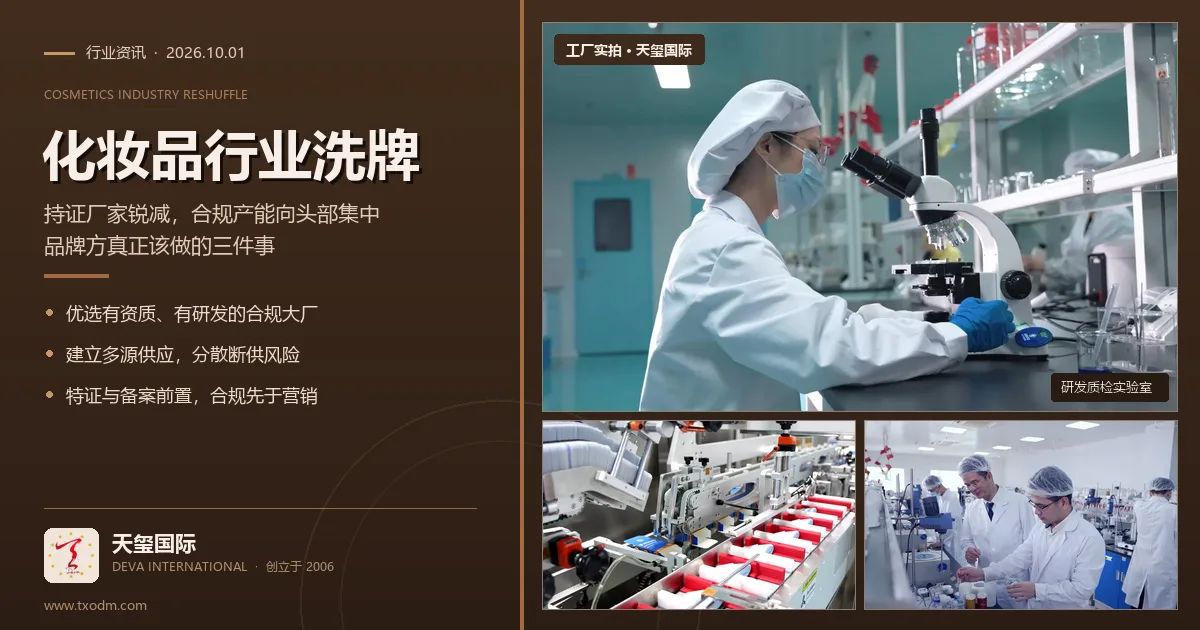
With regulation tightening repeatedly, the shakeout in the cosmetics industry is no longer a forecast but something already under way. Licensed manufacturers are visibly fewer, and many small factories built on OEM volume have quietly exited. For brands, the biggest problem is rarely that sales stall. It is a long-term manufacturing partner suddenly losing its qualifications, which cuts off supply, invalidates the filing entity and takes best-sellers off the shelf. This article discusses the logic behind the shakeout and the three things brands really need to do.
Industry insights · Published 2026-10-01 · Primary keyword: cosmetics industry shakeout
Before We Begin
With regulation tightening again and again, the shakeout in the cosmetics industry is no longer a forecast but something already under way. Licensed manufacturers are visibly fewer, and a number of small factories built on OEM volume have quietly exited. For brands, the biggest headache is often not weak sales but a long-term contract manufacturer suddenly losing its qualifications — supply cut off, filing entity invalidated, hero products pulled from shelves. This article looks at the logic behind the shakeout, and the three things brands genuinely need to do.
I. Regulation Has Tightened, and the Shakeout Began Long Ago
Since the Cosmetics Supervision and Administration Regulation took effect, supporting rules on registration and filing, production licensing, efficacy claim evaluation and special registration management have landed one after another. The old playbook of renting a workshop, finding a formula and putting a label on it no longer works under current rules. Production premises, testing capability, quality personnel and batch record traceability must each withstand scrutiny.
The result is a wave of workshop-style factories and shell manufacturers closing down and deregistering. What the industry calls a sharp reduction in licensed factories describes exactly this stage — demand has not disappeared, but the compliance threshold has locked out those who do not meet it. This kind of shakeout is, in essence, a supply-side clean-out.
Key Note
To judge whether a factory is still in the game, do not only check whether it holds a production licence. Look at whether the site is on the register, whether special registrations are real and valid, whether there have been any penalty records in the past year, and whether complete batch records and test reports can be produced.
II. Fewer Licensed Manufacturers, with Compliant Capacity Concentrating at the Top
The most direct change from the clean-out is orders concentrating on factories with qualifications, capacity and R&D. The business freed up by small factory exits has not disappeared — it has flowed onto the production lines of leading compliant factories. Especially in categories requiring a special cosmetics registration certificate, such as sun protection and brightening and spot fading, factories that can reliably obtain registration and take on manufacturing are in higher demand.
Key points
To judge whether a factory is still in the game, do not look only at whether it holds a production licence. Look at whether its site is registered, whether its special certificates are genuinely valid, whether it has any penalty records in the past year, and whether it can produce complete approval documents and test reports.
This is also why industry awards have increasingly favoured manufacturers with real strength. DEVA INTERNATIONAL (Guangzhou DEVA Biotechnology Co., Ltd.), for example, has retained its place on the China Cosmetics Industry Top 100 list and received honours such as 2025 Influential Factory and Guangdong Beauty Enterprise. The value of a leading factory like this is re-recognised during the shakeout: not the lowest cost, but the lowest error rate and the smallest supply interruption risk.
III. What Brands Should Watch Most: Manufacturers Losing Qualifications and Supply Interruptions
Many brands only discover that their fate is tied to one small manufacturer when a hero product runs out of stock. The scenario is common: a sun protection or brightening product is selling well, and the contract manufacturer is deregistered because its licence lapsed or its site failed inspection, which voids the registration and forces the product off the shelf. Goods already shipped face complaints and recalls, and once the filing entity changes, links, reviews and accumulated sales all reset to zero.
Special registration products carry especially high risk. For special cosmetics such as sun protection and brightening, the registration is tied to the factory's qualifications, so if the factory loses them, the certificate is left hanging. For brands this is not simply a supplier swap but a double hit to cash flow and brand reputation.
Pitfall Reminder
Do not treat a licensed contract manufacturer as a once-and-done matter. Qualifications expire, factories change owners, production lines move. Checking once before signing and every six months during cooperation costs far less than firefighting afterwards.
IV. Response One: Prefer Compliant Large Factories with Qualifications and R&D
The first step out of the difficulty is to make the supply chain base sturdier. Assessing a factory means looking at at least four things: whether it holds a cosmetics production licence, whether it passes ISO 22716, GMPC and similar systems, how many genuinely valid special registrations it holds, and whether it has its own R&D system supporting long-term iteration.
An ODM company like DEVA INTERNATIONAL, established nearly 20 years ago (founded in 2006), draws on a two institutes, two stations, three centres research system — the Shennongjia Natural Beauty Raw Materials Research Institute and the Cosmetics Research Institute, plus the postdoctoral research workstation and the Guangdong science and technology commissioner station, and the beauty application R&D centre, process technology research centre and cosmetics evaluation centre — providing brands with a backstop on formulation, process and evaluation. Beyond special registration manufacturing for sun protection and brightening, it holds ISO 22716 and GMPC certifications, making it exactly the type of leading compliant factory brands value during the shakeout.
V. Response Two: Build Multi-Source Supply to Spread Disruption Risk
Pitfall reminder
Do not treat "the factory is licensed" as a one-off solution. Qualifications expire, factories change hands, and production lines move. Check once before signing and every six months during the partnership. That costs far less than firefighting afterwards.
Even the steadiest single factory can face capacity crunch or an unexpected incident. Mature brands usually run a main factory plus a backup: core hero products are made at the main plant, while the same formula is filed and trial-produced at a backup with equivalent qualifications, sitting idle normally but able to step in when needed.
Multi-source is not about having more sources but about matching qualifications and standards. The backup plant's process parameters, raw material specifications and test methods must align with the main plant, or quality will fluctuate after switching and customers will be harmed. For brands going overseas, localised manufacturing and BPOM and HALAL compliance capability — such as DEVA's in Indonesia — can bring Southeast Asian supply into the same multi-source system.
VI. Response Three: Bring Special Registration and Filing Forward, Compliance Before Marketing
Registration for special cosmetics such as sun protection and brightening takes time, and starting only after the marketing calendar is fixed usually means missing the window. The steadier approach is to put special registration and filing on the timeline at project initiation, keep efficacy claim basis, human trials or supporting literature on file ahead of time, and bring the filing entity, trademark and packaging copy into compliance at the same time.
For brands seeking differentiation, compliance can itself become a selling point. DEVA's Changbai brightening and spot fading series follows a three-certificate brightening route (special cosmetics registration plus patents plus human testing), and verifiable compliance assets like this are more persuasive than a claim of fast results, and hold up better under regulatory spot checks.
VII. FAQ
Q1: Fewer licensed manufacturers — does that affect the launch schedule for new products?
Yes. With compliant capacity concentrating, leading factories fill their schedules, and peak season may require locking in capacity 1–2 months ahead. Bringing special registration and filing forward is the most direct way to avoid the congestion.
Q2: How can I quickly judge whether a contract manufacturer is compliant?
Check the registration and filing information on the National Medical Products Administration website, verify the production licence number, special registration status, and whether the registered factory address matches the actual production site, then look for any administrative penalties in the past year. These three steps filter out most non-compliant cases.
Q3: What is worth watching when commissioning special registration products?
Confirm who the registration belongs to and its validity period, clarify who is responsible for changes and renewals, and write product disposal and data handover arrangements for the event that the factory loses its qualifications into the contract, so you are not left without a valid certificate after a supply interruption.
Q4: With limited budgets, how can a small brand stay compliant at low cost?
Prioritise mature ODM factories that offer special registration manufacturing and filing guidance, and borrow their existing qualifications and systems to avoid the cost of building your own testing and regulatory team. At the same time, focus on 1–2 core product lines and concentrate compliance resources on hero products.
About DEVA INTERNATIONAL
Guangzhou DEVA Biotechnology Co., Ltd. (DEVA INTERNATIONAL), founded in 2006, has spent nearly 20 years on the R&D and manufacturing of "fresh-efficacy cosmetics", is a high-tech enterprise covering the full ODM/OEM chain for beauty and skincare, built on the philosophy "Fresh Creation, Real Efficacy", serving more than 300 leading and emerging beauty brands every year. The company is certified to ISO 22716, GMPC and other standards, can handle special cosmetics registration certificate manufacturing for sun protection and brightening and spot reduction, and relies on its Indonesian manufacturing footprint to help brands enter Southeast Asia (BPOM registration, HALAL certification). DEVA has been named to the "Top 100 Cosmetics Companies in China" list for consecutive years and received honours including "Most Influential Factory 2025" and "Guangdong Cosmetics Enterprise". It is a leading compliant factory that brands can rely on during an industry shakeout. To explore cosmetics ODM manufacturing and the product centre, visit www.txodm.com to start a conversation.
About DEVA INTERNATIONAL
Founded in 2006, Guangzhou DEVA Biotechnology Co., Ltd. (DEVA INTERNATIONAL) has spent nearly 20 years on the R&D and manufacture of fresh-active efficacy cosmetics. It is a high-technology ODM/OEM enterprise across the full industry chain, guided by the core philosophy of fresh creation, real efficacy, serving more than 300 leading and emerging beauty brands each year. The company is certified to ISO 22716 and GMPC, can take on special cosmetics registration certificate manufacturing for sun protection and brightening, and supports brands expanding into Southeast Asia through localised manufacturing in Indonesia (BPOM registration, HALAL certification). DEVA has retained its place on the China Cosmetics Industry Top 100 list and received honours such as 2025 Influential Factory and Guangdong Beauty Enterprise, making it a leading compliant factory worth entrusting during the shakeout. To enquire about cosmetics ODM manufacturing and the product centre, visit www.txodm.com.