
Cosmetics Safety Assessment Reports: What Brands Need to Know
Published 2026-11-19 16:02:00 · Tiensi
Contract manufacturing notes
Over the past two years, seven or eight out of ten emerging brands that come to us for manufacturing ask the same question: "Who actually produces the safety assessment report, and what has to be in it?" "In the past many brands launched new products on a formulator's say-so alone. Now the regulator has made safety assessment a mandatory gate before launch. Ordinary cosmetics need it, and special cosmetics such as sun protection and brightening need it even more. This article avoids jargon. It starts with the regulations, explains what the report actually contains, and then covers how brands and manufacturers work together, aiming to settle it in one pass.
Manufacturing Notes
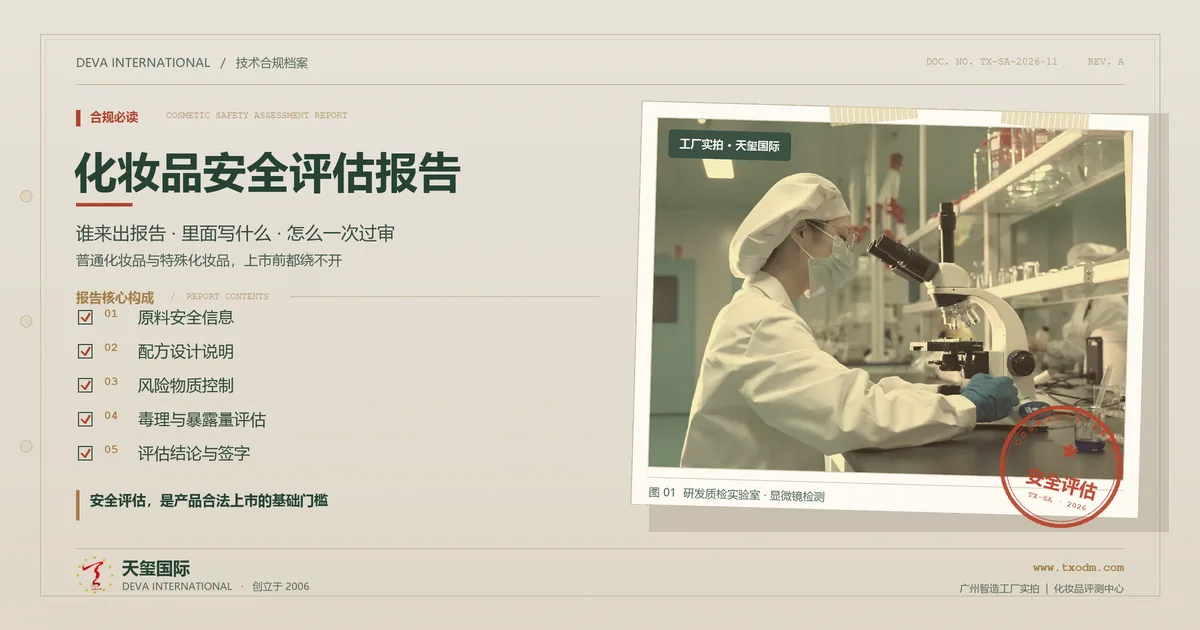
Over the past two years, seven or eight out of every ten emerging brands that come to us for manufacturing ask the same question: who actually prepares the safety assessment report, and what has to be in it? In the past many brands launched on a formulator's judgement alone; regulators now treat safety assessment as a checkpoint that must be cleared before launch. Ordinary cosmetics need it, and special cosmetics such as sun protection and brightening need it even more. This article skips the jargon, explaining the system, what the report actually contains, and how brands and manufacturers work together, all in one pass.
The conclusion first: a cosmetics safety assessment report is not a nice-to-have document but a basic threshold for a product to launch legally. It answers the question regulators and consumers care about most — is this product safe when used as directed. Here is the breakdown.
I. The Safety Assessment System: Required for Both Ordinary and Special Cosmetics
The Technical Guidelines for Cosmetics Safety Assessment (2021 edition) took effect in 2021, and with the transition period closing in 2024, safety assessment moved from encouraged to mandatory. Many brands still operate on the old assumption that only special cosmetics such as sun protection and brightening need assessment. That is a dangerous misunderstanding.
- Ordinary cosmetics: creams, cleansers, body lotions, shampoos and so on must complete a safety assessment before launch, with the assessment report submitted at filing.
- Special cosmetics: sun protection, brightening and spot fading, hair dyeing, perming, anti-hair-loss, spot fading and brightening, new raw materials and similar products must attach safety assessment materials at the registration stage, to a stricter standard.
Where is the difference? Ordinary cosmetics use filing, special cosmetics use registration, and the latter involves finer review over a longer period — but neither can bypass safety assessment. Brands planning both an ordinary line and a special registration line should list safety assessment documentation needs in the development schedule from project initiation, rather than patching it together just before launch.
II. What a Cosmetics Safety Assessment Report Actually Contains
A qualified safety assessment report is essentially about explaining why a product is safe, with evidence. Core content usually covers five areas:
1. Raw Material Safety Information
Every raw material needs an identity file: INCI name, CAS number, production process, specification and purity, safety use limits from authoritative databases (such as SCCS and CIR conclusions), and any risk substances that may be present. A formula may contain dozens of raw materials, and this list is the bedrock of the report.
2. Formula Design Description
State the product dosage form, pH value, application area (face or body), frequency of use, and target population (adult, baby-and-child, or pregnancy). The same ingredients used in a body lotion and around the eyes have entirely different safety boundaries.
3. Risk Control
Focus on risk substances: heavy metals, dioxins, asbestos, formaldehyde and formaldehyde releasers, pesticide residues and similar. Combining raw material characteristics with the process, demonstrate that actual carry-over of these substances is far below safe thresholds.
[Tip] Remember this one line
safety assessment report = raw material documentation + formula logic + risk justification + toxicological calculation + signed conclusion. Leave out any one of these and the regulator will send it back.
4. Toxicology and Exposure Assessment
This is the technical core of the report. The assessor calculates the margin of safety (safe dose divided by actual exposure dose), then factors in repeated use and contact time to judge whether the risk is acceptable. If the numbers do not hold up, the formula has to be revised.
5. Assessment Conclusion
Drawing on all of the above, give a clear conclusion that under normal, reasonable and foreseeable conditions of use, the product presents no acute or chronic health hazard, signed off by the safety assessor. If the conclusion cannot be written, the product cannot launch.
[Tip] One Line to Remember
A safety assessment report = raw material files + formulation logic + risk justification + toxicological calculation + signed conclusion. Miss any one block and the regulator sends it back.
III. Who Does It? Qualification Requirements for Safety Assessors
Not anyone can sign the report. A safety assessor needs professional knowledge of cosmetics quality and safety, familiarity with toxicology and exposure assessment methods, and the ability to judge independently whether the materials are sufficient. In practice, companies usually designate a specific person with a background in cosmetics, pharmacy, toxicology or a related field and hands-on experience, whose signature the report must carry and who bears the corresponding responsibility.
For small and mid-sized brands, maintaining an assessment team internally is expensive and impractical. The more realistic path is to draw on the manufacturer or a third-party testing body — provided they genuinely have the capability. DEVA INTERNATIONAL's two institutes, two stations, three centres R&D system includes a cosmetics evaluation centre, with dedicated teams supporting everything from raw material screening to stability, efficacy and safety validation, so assessors can work from measured data rather than writing a report in mid-air.
IV. How Brands and Manufacturers Collaborate
Safety assessment reports are rarely completed by the brand alone. Most often the manufacturer supplies the raw material and the brand handles compilation and archiving. How smoothly that collaboration goes directly determines the launch schedule.
Document Preparation: Build the Foundation
The manufacturer provides the complete formula list, the COA (quality specification) and MSDS (safety data sheet) for each raw material, and a description of the production process. The brand organises product positioning, instructions for use and packaging claims, ensuring consistency throughout and staying clear of exaggerated promotion.
Raw Material Reporting Codes: An Unavoidable Step
With the NMPA cosmetics raw material safety information registration platform now live, an increasing number of raw materials require a reporting code. Where a code exists, safety information can be retrieved directly by association, so the report is written faster and more rigorously. At the raw material selection stage, brands should confirm whether suppliers can provide a reporting code, otherwise it has to be added later in the assessment and costs a great deal of time.
[Caution] Collaboration reminder
Do not only think about the safety assessment once the finished product is off the line. Raw material submission codes, COAs and test data are best collected alongside formula design. With a responsive manufacturer, this can save two or three weeks from sampling to the finished report.
Test Data: Let Measurements Speak
Risk justification in the report cannot rest on literature alone. It needs product measurements: microbiological, heavy metal, stability and pH data. If the manufacturer can produce these reports in its own laboratory or through partner institutions, the delivery timeline for the whole safety assessment package can be shortened considerably. Backed by its cosmetics evaluation centre and process technology research centre, DEVA can complete multiple safety and stability validations during R&D, helping brands assemble assessment materials in one pass.
[Note] Collaboration Reminder
Do not wait until the finished product is off the line to think about safety assessment. Reporting codes, COAs and test data are best collected alongside formula design; with a cooperative manufacturer, sampling to report can save two to three weeks.
V. Common Misconceptions Among Brands
- Misconception one: only special cosmetics need assessment. Wrong — ordinary cosmetics filings also require an assessment report, and regulators check frequently.
- Misconception two: a safety assessment report is just a template. A template is only the format; usage levels, risk substances and margin of safety values all have to be calculated from your own formula, and copying leads to failure.
- Misconception three: a reporting code settles everything. A reporting code resolves the raw material layer, but overall formula compatibility, exposure and cumulative risk substances still require combined assessment.
- Misconception four: once assessed, it is done forever. Change a formula or swap a raw material and the assessment report must be updated, otherwise filing information and the physical product no longer match.
VI. FAQ: The Safety Assessment Questions Brands Care Most About
Q1: How long must the safety assessment report be kept?
By regulation, quality and safety records and assessment reports must be kept for a set number of years after the last batch of the product is launched (they are normally required to be retained and available for inspection). Brands should establish a complete archiving system so records can be retrieved at any time to respond to inspections.
Q2: If the formula is adjusted slightly, does the report need redoing?
It depends what changed. Swapping a risk substance or changing the level of a primary active ingredient basically requires re-evaluation; a fragrance supplier's internal batch adjustment with unchanged safety information can usually go through a change note. When unsure, ask the assessor.
Q3: How do imported cosmetics pass safety assessment?
Imported ordinary cosmetics use filing and special cosmetics use registration; both require safety assessment materials conforming to domestic guidelines. A report from the country of origin cannot substitute directly — it must be redone or supplemented under Chinese regulations.
Q4: What should a small brand without assessment capability do?
The most cost-effective option is to choose an ODM manufacturer with complete R&D and evaluation capability and hand formulation development, testing and safety assessment materials to one party, so documentation and product share a source and responsibility is clear. Factories like DEVA INTERNATIONAL, with a two institutes, two stations, three centres system and a cosmetics evaluation centre, can take this on end to end from R&D through compliance, saving the brand effort and avoiding pitfalls.
Brands planning sun protection, brightening and other special registration product lines should look ahead at the full compliance path for cosmetics ODM manufacturing and special registration manufacturing, planning safety assessment, registration filing and testing validation together for a steadier rhythm. More on products and R&D capability is available in the on-site product centre.
About DEVA INTERNATIONAL
About DEVA INTERNATIONAL
Guangzhou DEVA Biotechnology Co., Ltd. (DEVA INTERNATIONAL), founded in 2006, has spent nearly 20 years on the R&D and manufacturing of "fresh-efficacy cosmetics". It is a high-tech enterprise covering the full ODM/OEM cosmetics chain, integrating research and production, built on the philosophy "Fresh Creation, Real Efficacy". The company has built a "Two Institutes, Two Stations, Three Centers" research system (including a cosmetics evaluation centre) and operates two modern smart manufacturing plants in Guangzhou. It is certified to ISO 22716, GMPC and other standards, and can handle special cosmetics registration for sun protection and brightening and spot reduction, plus Southeast Asia compliance (BPOM, HALAL). Serving more than 300 beauty brands every year, its safety assessment and compliance capability is solid and reliable. Learn more at www.txodm.com.
Founded in 2006, Guangzhou DEVA Biotechnology Co., Ltd. (DEVA INTERNATIONAL) has spent nearly 20 years on the R&D and manufacture of fresh-active efficacy cosmetics. It is a high-technology ODM/OEM enterprise across the full industry chain, guided by the core philosophy of fresh creation, real efficacy. The company has built a two institutes, two stations, three centres research system that includes a cosmetics evaluation centre, operates two modern smart manufacturing plants in Guangzhou, and is certified to ISO 22716 and GMPC among others. It can take on special cosmetics registration manufacturing for sun protection and brightening, and Southeast Asian expansion compliance (BPOM, HALAL), serving more than 300 beauty brands each year with solid safety assessment and compliance capability. Learn more at www.txodm.com.