
Expanding to Southeast Asia: DEVA's Indonesia Factory Advantage
Published 2026-11-25 17:42:11 · Tiensi
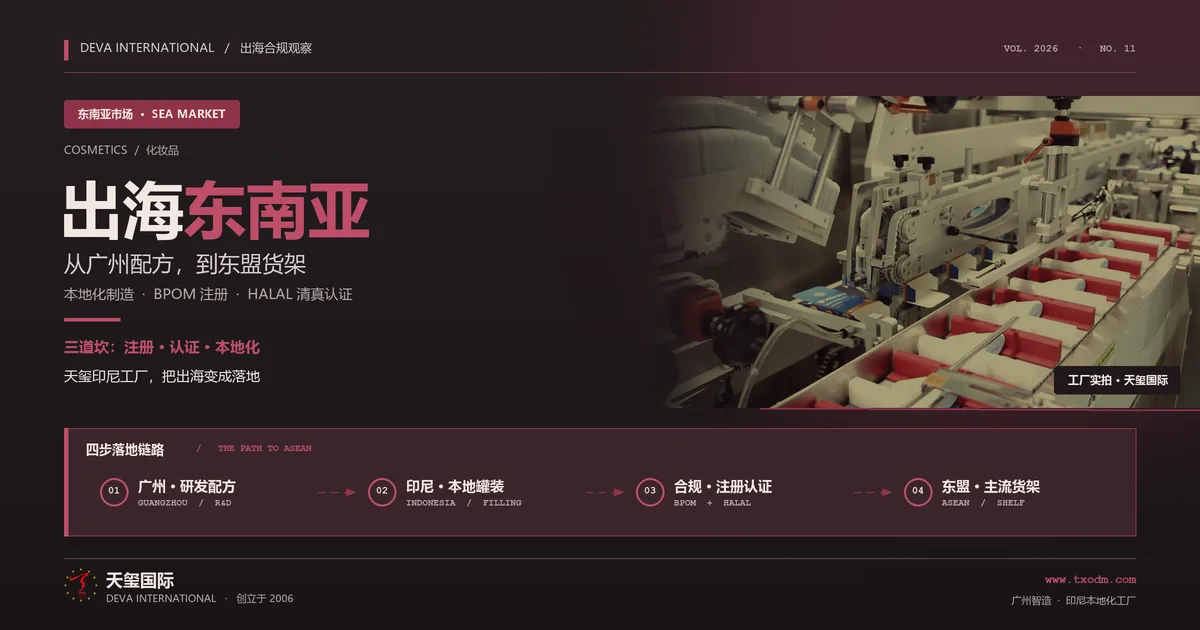
Within ASEAN's ten markets, Indonesia, Vietnam, Thailand and the Philippines drive beauty consumption. Indonesia alone has close to 280 million people, the fourth-largest population in the world, and more than 60% of them are under 40. Being young, beauty-minded and highly responsive to social recommendations, this combination makes beauty one of the fastest-repurchase categories in cross-border trade. Many categories that are oversaturated at home open up fresh stories in Southeast Asia.
More importantly, there is the halal economy. Indonesia, Malaysia and Brunei have predominantly Muslim populations, so HALAL certification is effectively a ticket to the mainstream channels. This is both a barrier and an opportunity. A brand that holds the certification holds a ticket to trust covering hundreds of millions of people, and competitors cannot easily replicate this compliance chain in the short term. Looking at channels, Shopee, Lazada and TikTok Shop penetrate Southeast Asia far more deeply than many in China assume. A young consumer in Vietnam or Indonesia might see a review on TikTok in the morning and place the order on Shopee by midday. This "content is the shelf" path suits asset-light, fast-turnover emerging brands well and reduces the capital strain of traditional offline distribution. The vision is generous; execution is lean. Among the brands we work with, seven or eight out of ten get stuck on the three points below. Thinking through these three hurdles matters far more than shipping quickly. Indonesia's regulator is BPOM (Badan Pengawas Obat dan Makanan, the Indonesian food and drug authority). To be sold legally in Indonesia, imported cosmetics must first obtain a BPOM registration number. This feels quite different from filing in China: materials must be in Indonesian, ingredients must meet the local positive list, labelling must follow local rules, and the review cycle is usually counted in months. Without a registration number there is no way into formal e-commerce or offline channels. Trading stays within small private circles and volume never builds. In markets where Muslim consumers are the majority, HALAL certification means the product contains no prohibited substances and no cross-contamination from raw materials through production equipment to the filling environment. Certification is issued by the local authoritative body, and the process covers document review, on-site factory inspection and annual supervision. Many brands are not limited by the product but stuck in the certification chain, unable to list for months while the window passes. Even with registration and certification complete, cross-border direct shipping costs, lengthy customs clearance and repeated mark-ups between "a Guangzhou factory and a Jakarta shelf" leave almost nothing of the margin. What brands genuinely need is a partner with local capacity, compliance capability and cost control, not yet another factory that only takes production orders. DEVA INTERNATIONAL holds a stake in local manufacturer MICOS in Indonesia, following exactly the "local manufacturing plus local compliance" route. The partnership model is clear, and brands can see at a glance where their own role ends. DEVA supplies the formula and semi-finished product, which are shipped with packaging to the Indonesian plant MICOS for filling and packing into finished goods; the Indonesian plant handles BPOM registration and HALAL certification. In other words, the brand completes the most important part, R&D and formulation, in Guangzhou, and leaves the asset-heavy, compliance-heavy work to a factory already established locally. That preserves technical initiative while avoiding most of the pitfalls of cross-border shipping. For brands preparing to scale in Southeast Asia, this means small trial orders control risk early and capacity scales only after the channel is proven. The cost curve slopes smoothly downward instead of the awkward situation where scaling up makes each unit more expensive. DEVA INTERNATIONAL did not decide to go overseas on a whim. As an ODM company that has spent nearly 20 years on the R&D and manufacturing of "fresh-efficacy cosmetics", it is headquartered and manufactured in Guangzhou, is certified to ISO 22716, GMPC and other standards, and can handle special cosmetics registration certificate manufacturing for sun protection and brightening and spot reduction, plus overseas compliance. Built on the "Two Institutes, Two Stations, Three Centers" research system and technologies such as microencapsulation and targeted transdermal delivery, product strength is the foundation of this market-entry plan. In December 2025, DEVA exhibited at the Vietnam International Beauty Expo in Ho Chi Minh City (booth B1-C21/C22), bringing "Made in China" fresh-efficacy products directly to ASEAN buyers. Industry recognition followed in the same period: DEVA was named "Super Factory of the Year" (2024) and "Most Influential Factory 2025" at the TipTop Global Beauty Awards. When negotiating partnerships overseas, such credentials are often the first trust credential a brand hands an international client. If you are planning to sell into Southeast Asia, work through these steps in order to avoid the pitfalls. First, choose the market. Indonesia and Malaysia respond to HALAL, while Vietnam and Thailand respond to social-commerce recommendations. Spreading yourself across all of them at once only dilutes resources and gets nothing off the ground. Second, find the right partner. Prioritise manufacturing partners with a local plant that can handle BPOM and HALAL. That is far less troublesome than shipping only from China and keeps compliance risk out in front. Third, place a small trial order. Start with MICOS's sliding-scale quote at 5,000 units to validate the channel before scaling up, which keeps early trial-and-error cost under control. Fourth, treat compliance as part of product strength. The registration number and certification are not a cost burden. They are the ticket to mainstream channels and consumer trust. To learn more about DEVA's cosmetics ODM manufacturing and market-entry compliance services, see the service page skincare_oem_odm_service.html, contact us via contact.html, or browse the product centre products.html. Q1: Does the brand need to handle BPOM registration in Indonesia itself? No. Under DEVA's partnership model with the Indonesian plant, BPOM registration and HALAL certification are handled by the local plant. The brand only needs to supply the formula and documents rather than working through Indonesian-language regulations itself. Q2: Is the logistics of exporting semi-finished product from China to Indonesia complicated? Exporting semi-finished product and packaging falls under ordinary trade and is arranged jointly by DEVA and the plant. It is far more manageable on customs clearance and duty than importing finished goods by the full container, and it avoids the heavy tariffs and long-distance loss on finished goods. Q3: What is the minimum order quantity for a small brand starting out? Taking specifications above 30 ml/g as an example, filling can start at 5,000 units. This suits a small trial order to test the ASEAN market first, scaling up once the channel is proven. Q4: Can DEVA take special-certificate products overseas? Yes. DEVA holds special cosmetics registration certificate manufacturing qualifications for sun protection and brightening and spot reduction. These products can also use the Indonesian local filling plus registration and certification route, so special-certificate compliance is handled in the same pass.
Expanding cosmetics into Southeast Asia has become a growth consensus for many emerging brands over the past two years. Southeast Asia is not a downscaled version of China — it is a young market of over 680 million people with a median age below 30 and extremely high social media penetration. For brands selling into ASEAN, the opportunity is genuinely there — but so are the real thresholds. Registration, certification, localisation: if any one of them stalls, goods pile up at customs or the online store never opens. This article looks at the real path for cosmetics expanding into Southeast Asia, and how DEVA INTERNATIONAL uses a single Indonesian plant to turn a hard problem into something a brand can act on day to day.
Cosmetics in Southeast Asia: An Underestimated Growth Pole
Within the ten ASEAN countries, Indonesia, Vietnam, Thailand and the Philippines are the core markets for beauty consumption. Indonesia alone has close to 280 million people, the fourth largest population in the world, with more than 60% under 40. Young, appearance-conscious and highly responsive to social media recommendation — together these traits make beauty one of the fastest-repeat-purchase categories in cross-border trade. Many red-ocean categories that stall domestically find a new story in Southeast Asia.
More important is the halal economy. Indonesia, Malaysia and Brunei have predominantly Muslim populations, and for cosmetics to enter mainstream channels, HALAL certification is close to an entry ticket. This is both a barrier and an opportunity — a certified brand holds a trust pass valid for hundreds of millions of people, and competitors cannot easily replicate this compliance chain in the short term.
On channels, Shopee, Lazada and TikTok Shop penetrate Southeast Asia far more deeply than many expect. A young consumer in Vietnam or Indonesia might see a review on TikTok in the morning and order on Shopee at lunchtime. This content-as-shelf journey is friendly to asset-light, fast-turnover emerging brands and reduces the capital pressure of traditional offline distribution.
Three Obstacles You Cannot Avoid When Expanding into Southeast Asia
The ambition is high and the reality is tough. Among the brands we have worked with, eight or nine out of ten get stuck on the three things below. Thinking these obstacles through clearly matters far more than shipping quickly.
First Obstacle: BPOM Registration Is Not Simply Filing
Indonesia's regulator is BPOM (Badan Pengawas Obat dan Makanan, the Food and Drug Supervisory Agency). Imported cosmetics must obtain a BPOM registration number before they can be legally sold in Indonesia. This is quite different from domestic filing in feel: materials must be in Indonesian, ingredients must meet the local positive list, labels must follow local rules, and review periods are usually measured in months. Without a registration number, the product cannot enter formal e-commerce or offline channels and circulates only in small private circles, so volume never builds.
Second Obstacle: HALAL Certification
In a market where Muslim consumers are the majority, HALAL certification means the product contains no prohibited ingredients from raw materials through production equipment to the filling environment, with no cross-contamination. Certification is issued by local authoritative bodies, and the process includes document review, on-site factory inspection and annual supervision. Many brands are not failing on the product — they are stuck in the certification chain and unable to list, watching the window close.
Third Obstacle: Localisation and Cost
Even with registration and certification settled, cross-border direct shipping costs, lengthy customs clearance and repeated mark-ups between a Guangzhou factory and a Jakarta shelf leave little margin. What brands actually need is a partner with local capacity, local compliance capability and cost control — not another contract manufacturer that only handles production.
Pitfall Reminder
Do not treat finding a domestic manufacturer and shipping a full container to Southeast Asia as an expansion plan. Cross-border shipping means duties, import registration and long-distance logistics losses; if one batch contains an ingredient not on the local list, the cost of sending the whole container back far exceeds the compliance investment made earlier. Local manufacturing plus local registration and certification is the sustainable route that can run for over a year.
DEVA INTERNATIONAL's Indonesian Plant MICOS Turns Expansion Into Delivery
DEVA INTERNATIONAL holds a stake in local manufacturing plant in Indonesia, following exactly the localised manufacturing plus local compliance route. The collaboration model is clear enough that brands can see at a glance where their own role ends.
DEVA supplies the technical formula and semi-finished product, exporting semi-finished goods and packaging to the Indonesian plant MICOS for filling and packing into finished goods; the Indonesian plant handles BPOM registration and HALAL certification. In other words, the brand completes the most valuable part — R&D and formulation — in Guangzhou, and hands the asset-heavy, compliance-heavy part to a plant that is already on the ground. Technical initiative stays with you, while most of the cross-border pitfalls are avoided.
This Model Means Three Things for Brands
1. Formulation and efficacy stay under DEVA's control, so product strength is not diluted and the selling points remain yours;
2. Finished products are filled locally in Indonesia, avoiding the high duties on full-container imports and lengthy customs clearance;
3. BPOM and HALAL are handled directly by the local plant, so the brand does not have to work through Indonesian-language regulations and inspection procedures alone.
From Guangzhou Formulation to ASEAN Shelf: DEVA's Expansion Service Chain
DEVA INTERNATIONAL did not enter expansion on a whim. As an ODM company focused on the R&D and manufacture of fresh-active efficacy cosmetics for nearly 20 years, with headquarters and factories in Guangzhou and certifications to ISO 22716 and GMPC, it can take on special cosmetics registration certificate manufacturing for sun protection and brightening as well as overseas compliance. Backed by the two institutes, two stations, three centres research system and by microencapsulation and targeted transdermal delivery technologies, product strength is the foundation of this expansion proposition.
In December 2025, DEVA appeared at the Vietnam International Beauty Expo in Ho Chi Minh City, booth B1-C21/C22, bringing fresh-active products made in China directly to ASEAN buyers. Industry recognition arrived at the same time: DEVA was named Super Factory of the Year (2024) and 2025 Influential Factory in the TipTop Global Beauty Awards, and endorsements like these are often the first trust card a brand hands to overseas partners when discussing cooperation.
Practical Advice for Brands Preparing to Expand
If you are planning to sell into Southeast Asia, working through these steps in order will save a few pitfalls:
Step one: choose your market first. Indonesia and Malaysia are about HALAL; Vietnam and Thailand are about social media recommendation. Spreading resources across all of them means none takes off.
Step two: find the right partner. Prioritise manufacturers with their own plant locally who can handle BPOM and HALAL — far less hassle than shipping from China, and it puts compliance risk behind you.
Step three: run a small trial order. Use MICOS to test 5,000 units in the channel first, then decide whether to scale, keeping early trial-and-error cost controllable.
Step four: treat compliance as part of product strength. A registration number and certification are not a cost burden; they are the ticket into mainstream channels and the basis for consumer trust. To learn more about DEVA's cosmetics ODM manufacturing and overseas compliance services, see the service page skincare_oem_odm_service.html, contact contact.html, or browse products.html in the product centre.
FAQ
Q1: Does a brand need to handle BPOM registration in Indonesia itself? No. Through the collaboration model with DEVA's Indonesian plant MICOS, BPOM registration and HALAL certification are handled by the local plant, and the brand only needs to supply the formula and documentation rather than working through Indonesian-language regulations alone.
Q2: Is exporting semi-finished goods from China to Indonesia logistically troublesome? Exporting semi-finished goods and packaging falls under ordinary trade arrangements, coordinated by DEVA and the plant, and is more manageable than full-container finished goods imports on both customs and tax, while avoiding the high duties and long-distance losses of importing finished goods.
Q3: What is the minimum order quantity for a small brand starting out? Taking specifications above 30ml/g as an example, filling can start at 5,000 units — suitable for testing the ASEAN market in small batches before scaling up.
Q4: Can DEVA take special registration products overseas? Yes. DEVA holds special cosmetics registration certificate manufacturing qualifications for sun protection and brightening, and these products can also use the Indonesian local filling plus registration and certification route, landing special registration compliance at the same time.
About DEVA INTERNATIONAL
Founded in 2006, Guangzhou DEVA Biotechnology Co., Ltd. (DEVA INTERNATIONAL) is a high-technology ODM/OEM enterprise across the full industry chain, focused on the R&D and manufacture of fresh-active efficacy cosmetics for nearly 20 years. Guided by the core philosophy of fresh creation, real efficacy, it serves more than 300 leading and emerging beauty brands each year. The company holds a stake in local manufacturing plant MICOS in Indonesia, supporting BPOM registration and HALAL certification, and has been named Super Factory of the Year (2024) and 2025 Influential Factory in the TipTop Global Beauty Awards, helping brands expand into Southeast Asia. Learn more at www.txodm.com.
Pitfall reminder
Do not treat "find a domestic manufacturer, then ship a full container to Southeast Asia" as a market-entry plan. Cross-border shipping means duties, import registration and long-distance logistics loss. If any batch contains ingredients that do not meet the local list, the cost of returning a full container far exceeds the compliance investment made earlier. Local manufacturing plus local registration and certification is the sustainable route that can work for more than a year.
What this model means for brands
1. DEVA controls the formula and efficacy, so product quality is not compromised and the selling points remain yours. 2. Finished goods are filled locally in Indonesia, avoiding the heavy tariffs and lengthy customs clearance of a full-container import. 3. BPOM and HALAL are handled end to end by the local plant, so the brand does not have to work through Indonesian-language regulations and factory inspections alone.